
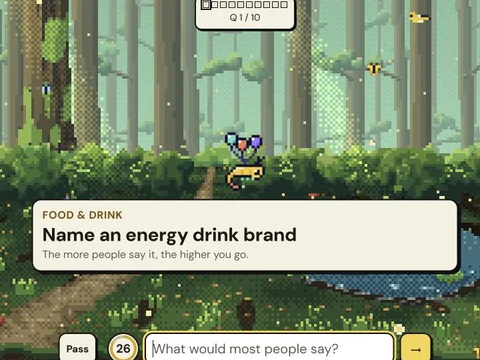
What kind of game is Crowdict?
Crowdict asks you to name something that fits a category. A conventional quiz often has one intended answer; here a prompt can have many valid answers. The interesting decision is which valid answer to submit. In Crowd mode, a response that many people would think of earns a stronger band. In Rare mode, a valid response that fewer people would think of can earn the stronger band. The Daily presents ten shared questions and gives you thirty seconds for each response. You can play in a browser without creating an account. This guide explains the decisions you control, the limits of what a player can know in advance, and a practical way to learn from every reveal.
The first thing to separate is validity from popularity. A surprising answer has no strategic value if it does not fit the category. A familiar answer can be an excellent Crowd choice and a modest Rare choice while remaining equally correct. The game's estimate of answer popularity determines its band. It is prepared for the question rather than measured from a live vote during your run. You therefore cannot determine an exact band by watching what other players type. You can only reason about the kind of answer a person would recall quickly and check whether your proposed answer satisfies the words on the card.
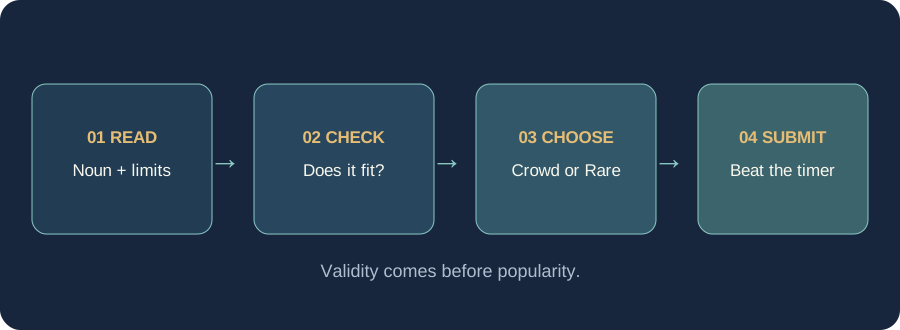
This is also why a single rule such as “always say the first thing you think of” cannot cover every prompt. First instincts can be useful evidence of salience in Crowd mode. They are much less useful when the prompt contains a condition you almost missed, or when you have chosen Rare. A simple sequence works better: read the whole prompt, identify the category and any limits, name one answer you trust, then decide whether a stronger answer is worth the remaining time. If you are uncertain, submitting a valid answer beats spending the whole timer on an elegant idea you never enter.
The shape of a Daily run
Before the first question, choose Crowd or Rare. The two modes use the same Daily questions but have separate scores and leaderboards. A new Daily arrives at midnight in your local time. A run has ten prompts, and the later prompts carry larger multipliers. After each submitted answer, the reveal displays the scoring band and the points it earned. At the end, the game totals your ten rounds and lets you review or share the result. The scoring guide walks through the numbers; for a first game, it is enough to know that a valid answer always has a chance to score and a pass or timeout scores zero.
The timer creates two kinds of pressure. One is recall: you may know the category but take too long to retrieve a name. The other is interpretation: you may retrieve a name quickly but have misread a word such as “capital,” “winner,” or “before.” Give interpretation a protected first few seconds. It is tempting to type immediately because the clock is visible, yet a quick answer to the wrong question can cost more time when the game refuses it. After you understand the scope, a reliable answer can be entered quickly. If the game does not accept it, try another while time remains.
Crowdict recognizes many common answer variants and small spelling differences, but its answer lists are not complete. A refusal is not always proof that your general knowledge is wrong. Check the wording and your spelling, then move to another candidate if the clock allows. The creator offers a way to report a missed valid answer. For a player trying to finish a run, the important distinction is between resolving a possible typo in seconds and arguing with the answer bank while the timer expires. Save the latter for after the round.
A simple decision routine
Use a three-pass scan of the prompt. First, identify the requested kind of thing: country, food, bird, city, player, or another category. Second, underline the limiting words mentally: a date, a location, a qualification, a plural, or an exclusion. Third, ask how your scoring mode changes the answer you want. Crowd asks what a typical player would say immediately. Rare asks what correct response might be overlooked. The category and limits decide eligibility; the mode decides which eligible answer you prefer.
Try a practice prompt invented for this guide: “Name a piece of playground equipment.” A swing and a slide are easy to imagine and are plausible Crowd candidates. A climbing frame may also fit, though its score is not knowable from the prompt alone. In Rare, you might consider a less immediate item, but you still need an item that reasonably belongs to a playground. “Tree” sounds unusual but can be outside the intended category. This example is about method, not a promise that any item belongs to a particular band in the live game.
Now add a limit: “Name a capital city in Europe.” The word “capital” eliminates many familiar European cities. The word “Europe” can introduce boundary questions for some places, so a player with little time may choose an unambiguous capital. A Crowd player might favor a prominent city; a Rare player may recall a smaller capital. Both must pass the same validity check. This illustrates the central habit of the game: ranking an answer by expected familiarity comes only after deciding that it belongs to the category.
When to answer and when to keep thinking
An early, valid answer is a useful floor. It protects against a timeout and often gives you time to think about a replacement if the interface permits another submission after a rejected guess. But continuing to search after you have a strong candidate can make you second-guess a sound instinct. Set a personal cutoff: once the timer is low, choose the best candidate that you can defend in one sentence. You need not prove it would win the board; you need to know why it fits.
In Crowd, consider whether the first answer in your mind is a shared cultural default or merely a personal association. If a prompt asks for a fruit and you recently bought a mango, “mango” may feel instant to you while “apple” may be more immediate to a wide audience. In Rare, the same personal association can help if it is clearly valid. The point is not to suppress your instincts. It is to notice whose memory they represent. Ask, “Would many players retrieve this under the same time limit?” and change direction only when that question gives a clear reason.
Some prompts reward a short list in your head. Generate three plausible answers, reject any that violate the wording, then pick according to the mode. Do not try to enumerate the whole category. Thirty seconds is enough for a short comparison, not for exhaustive research. A good short list contains one safe candidate, one strategic candidate, and, if needed, one backup. A safe candidate is easy to verify. A strategic candidate may score better but requires a little more confidence. A backup keeps you moving if the first text is not recognized.
Read the reveal as feedback
The reveal answers a narrow question: how did the submitted answer score under this game's prepared bands for this prompt? It does not prove what every player would say in a conversation, and it is not a live poll of the people playing today. A surprising band is still useful feedback. If you thought an answer was obvious and it landed low in Crowd, perhaps the category pulled most players toward a different default. If an apparently obscure answer landed low in Rare, perhaps it was more salient than you expected, or the game's estimate differs from yours.
Learn from the difference between your prediction and the band. You can keep a tiny mental note after each round: “I expected top five; got top ten,” or “I worried that would be common; got Hidden Gem.” The purpose is to adjust your sense of shared recall. Do not infer that a nearby prompt will use the same ranking. The exact category and wording matter. A city can be a prominent answer to a tourism prompt and a much less obvious answer to a prompt about capitals, rivers, or climate.
Your total is also a combination of band and round weight. A late answer can make a large difference, but the higher multiplier does not make a low-confidence guess automatically wise. A valid lower-band response in a late round can still add points; an invalid response adds none. The scoring and multipliers guide provides worked examples so you can see where the points come from rather than relying on the visual drama of a stage animation.
Common beginner mistakes
The first mistake is answering the category you expected instead of the one displayed. A question that includes a time period, a geographic scope, or a specific achievement is narrower than a general list of famous examples. The fix is to pause long enough to say the full condition in your own words. “I need a capital in Europe,” not merely “I need a European city.” That one sentence often prevents a rushed invalid answer.
The second mistake is treating Rare as a contest to produce the strangest word. Obscurity only matters after validity. A lesser-known member of the requested category is useful; an item adjacent to the category is not. Rare can also punish an answer that is so obscure you cannot recall its exact form or verify that it meets the prompt. A moderately uncommon answer you trust can be better than a fanciful possibility that consumes the timer.
The third mistake is assuming an answer's length or spelling determines its points. The game scores an accepted answer according to its band, not the number of letters you typed. Use the clearest conventional name you know. If the game recognizes a variant, you should expect the underlying answer to be what matters. If it does not recognize the wording, a simpler name or a different accepted answer may rescue the round.
The fourth mistake is turning a single low score into a rigid rule. Perhaps “apple” was obvious on one fruit prompt; that does not mean it is always the top response whenever fruit appears. Small changes in wording change the pool of valid answers and the likely first thought. Use the reveal to refine a habit of reading, not to memorize a single answer for every topic.
Practice without spoiling the Daily
Unlimited is a useful place to experiment after you understand the basic flow. It offers runs beyond the Daily and can focus on a topic or mix topics. You can test an approach such as “three candidate answers before I submit” without replacing the day's shared result. The creator also offers different stages for the Daily. The stages change the setting while preserving the questions and scoring. Use the view that helps you stay focused; there is no scoring advantage from switching scenery.
If you want structured practice, use a notebook with four columns: prompt condition, your answer, predicted band, revealed band. Add a fifth column for what you missed in the wording. After several sessions, you may discover a pattern. You may overestimate how many people know specialist examples. You may underestimate how many players reach for a particular everyday item. Or you may simply answer too slowly on broad categories. Each pattern suggests a different adjustment; no universal “best answer” list can replace that observation.
You can also rehearse with invented prompts away from the game. Ask a friend to name a flower, a musical instrument, a coastal country, or a team sport in five seconds. Then compare your first answers. This is not a scientific popularity survey and does not predict the game's bands. It is a way to notice that different people retrieve different examples from the same category, which is the mental skill Crowdict uses. Keep the invented prompts clearly separate from actual Daily questions so you do not confuse a practice exercise with game data.
Your first five games
For your first game, finish all ten questions and learn the interface. Choose a valid answer before chasing a perfect band. For the second, decide on a simple Crowd routine: read, check the limit, imagine the most familiar example, submit. For the third, try Rare and discover how much more time you spend validating less obvious examples. For the fourth, compare your predicted bands with the revealed bands. For the fifth, try a topic in Unlimited or a different stage, then return to the Daily with one specific habit you want to improve.
These are learning targets, not required milestones. You may prefer one mode and ignore the other. The important improvement is to make your reasoning explicit enough to change it. If you cannot explain why an answer fits, the timer may be pushing you into a guess. If you can explain why it fits but cannot estimate its familiarity, you still have a playable answer. If you can do both, you have made the strategic choice Crowdict asks you to make.
Quick reference
- Read the complete prompt before ranking possible answers.
- Decide whether the answer fits, then decide whether it suits Crowd or Rare.
- Keep one safe candidate available while searching for a stronger one.
- Use the reveal to update your expectations about this prompt, not to invent a universal rule.
- A pass or timeout earns zero; an accepted answer can earn points even when it is not the top answer.
- Practice in Unlimited and use stages for the setting you enjoy.
For the next step, read Crowd mode strategy or Rare mode strategy. Both develop the same reading habit in different directions.
Keep exploring
Practice these ideas in the game, then compare your choices with the reveal. A scoring band is feedback for the next question, not a guarantee about a future answer.