
Why reading is a scoring skill
Crowdict makes an answer feel urgent by putting a timer beside the prompt. That pressure can make a familiar noun dominate your attention while a smaller word defines the actual answer set. A question asking for a city is different from one asking for a capital; a player is different from an award winner; a country is different from a country with a specified geographic feature. The scoring mode only matters after this boundary is clear. If your answer does not fit, being common or rare cannot rescue it. Careful reading is therefore not a slow preliminary task. It is part of the strategy that lets you make a valid decision quickly.
This guide offers a reusable method for the Daily and themed games. The practice prompts are invented editorial exercises, not current or past Crowdict questions unless explicitly identified as such. Their purpose is to show how small changes in wording alter eligibility and the likely Crowd or Rare decision. You can use them without learning an answer key, because the skill is to notice categories and conditions under a time limit.
Separate the noun from the filter
Most category prompts contain a core noun: bird, food, city, country, NBA player, and so on. They may also contain one or more filters: location, time, physical property, achievement, material, or relationship. Mentally rewrite a prompt as “one [noun] that [filter].” For example, “Name a capital city in Europe” becomes “one city that is a capital and is in Europe.” This version makes it harder to submit a famous European city that is not a capital. It also makes the question's proof clearer: you can check each filter separately.
The filter can be a short preposition. “From,” “in,” “with,” “before,” and “after” are easy to read past. Yet they can change an answer completely. “A player from a team” may ask for someone who played there; “a player who won with a team” requires a different fact. “A country in a region” differs from “a country bordering a region.” If a candidate fits only after you quietly replace the preposition with another, do not use it. The game's answer list is built around the actual prompt, not your paraphrase.
Numbers deserve their own check. A year range, minimum, maximum, or ordinal position can exclude an otherwise famous example. In an NBA prompt, first overall is not simply “picked early.” In a geography prompt, a population threshold is not a general impression of size. If you cannot remember the relevant number, choose a candidate whose eligibility you know more directly. Timed play rewards clear facts more than confident approximations.
Test the answer with a short proof
After retrieving a candidate, try to finish this sentence: “It fits because…” The proof should mention the actual condition. “Paris fits because it is a European capital” is a direct proof for that invented prompt. “Barcelona fits because it is a famous European city” proves a different statement and exposes the mismatch. This test takes only a moment once you practice it. It is especially helpful in Rare mode, where less obvious candidates may sit near category boundaries.
A proof can be uncertain. You may think a country is landlocked but not remember whether it has a short coast. You may think a basketball player won an award but remember only a nomination. Notice the uncertainty instead of hiding it. A safe backup may be a better timed answer. You do not need absolute certainty for every game choice, but you should know which part of the condition you are unsure about. That knowledge lets you decide whether the potential band improvement is worth the risk.
Do not overcomplicate an ordinary category. If a prompt asks for a fruit and you have a familiar fruit, no elaborate taxonomy is required. The proof method is a guardrail, not a request to argue over every word. Spend more attention on prompts with multiple clauses, qualifiers, or specialist categories. The goal is to remove avoidable invalid submissions while keeping the pace of play.
Spot hidden alternatives
Some prompts can be read in more than one plausible way. A phrase such as “connected to” or “associated with” is looser than “won” or “borders.” When the game offers a broad relationship, prefer a candidate with a direct, widely understood connection. A technical or distant association may be defensible in conversation yet absent from the answer list. If a question has an explicit source or reveal explanation, read it afterward to learn the intended scope. During the timer, choose the clearest candidate you have.
Category labels can also be everyday rather than scientific. A food called a vegetable in cooking may be classified differently in botany. A keyboard instrument may contain strings but be grouped differently by ordinary players. Crowdict aims to recognize many valid answers, yet no list is complete. When a boundary is contestable, decide whether you want to risk that argument under a countdown. An unambiguous answer can be more strategically useful even if it seems less clever.
The word “name” usually requests one answer, not a list. Avoid entering multiple alternatives in one field unless the game explicitly asks for them. A single clear conventional name is easier for an answer system to recognize and easier for you to evaluate against the prompt. If the first answer is rejected, try another while time remains. The creator says common variants and small spelling differences may be recognized, but an ordinary name is still the safest starting form.
Practice: one word changes the category
Invented prompt A: “Name a European city.” Invented prompt B: “Name a European capital.” Both ask for a place, but B has a civic filter. A city that is famous for football, art, or tourism may fit A and fail B. A Crowd player should find a familiar member of the correct set; a Rare player should find a less familiar member of the correct set. The popularity comparison occurs inside the set. Use this pair to practice mentally rejecting a highly salient but invalid response without feeling that you have lost a good answer.
Invented prompt A: “Name an animal that can fly.” Invented prompt B: “Name a bird that can fly.” B excludes flying mammals and insects because it specifies birds. It may also exclude birds that cannot fly. The second prompt therefore has two tests: bird and flight. A player chasing a Rare response might think of an uncommon flying animal, but that is useful only for A. This is a simple example of how a prompt can narrow the noun and add a property at the same time.
Invented prompt A: “Name a food served cold.” Invented prompt B: “Name a dessert served cold.” A broad chilled dish can fit A. B asks for a subset that functions as dessert. A savory cold dish may be a strong response to A and invalid for B. Now add “usually” before “served cold.” The prompt may become about typical presentation rather than a dish that can occasionally be chilled. Small qualifiers change the burden of proof.
Practice: time and achievement
Invented prompt A: “Name an NBA player who reached an All-Star team.” Invented prompt B: “Name an NBA player who won a particular award.” An All-Star selection does not prove an award win. A player's fame, career length, or team success may make a name feel relevant, but the condition is a discrete achievement. In a real NBA round, read the exact award and years shown on the card. Then think of a player whose eligibility you can connect to that achievement, and only afterward consider whether that player is common or rare.
Invented prompt A: “Name a film released in the 1990s.” Invented prompt B: “Name a film set in the 1990s.” Release date and story setting are different properties. A film can be released later and set earlier. If you remember only that a film evokes a decade, you may not know which statement is true. This practice pair encourages you to turn a vague association into a factual test. The same principle applies to historical periods, sporting seasons, and geographic labels.
Invented prompt A: “Name a person who played for a team.” Invented prompt B: “Name a person who won a championship with that team.” Playing for the team is necessary for B but not sufficient. A famous transfer may be easy to recall but have left before the title season. For a timed answer, prefer a candidate whose tenure and achievement you can place together. Rare mode is especially tempting here because an obscure former player may seem promising while the championship connection remains uncertain.
Practice: geography wording
Invented prompt A: “Choose a country in Africa.” Invented prompt B: “Choose a country bordering the Atlantic Ocean in Africa.” B includes a coast condition. A landlocked country can be perfectly valid for A and invalid for B. The map may make the coast visually clear, but small country shapes and zoom levels can mislead. Read the words first, orient on the map, and use search if you already know a candidate but cannot tap it reliably. This is a reading exercise, not a claim about a live Geo clue.
Invented prompt A: “Choose an island country.” Invented prompt B: “Choose a country with an island.” Many mainland countries have islands, while “island country” may be interpreted more narrowly. If you silently replace A with B, you enlarge the answer set incorrectly. For a borderline example, inspect the game's reveal sources later. During a timed round, choose a country with a clear relationship to the requested phrase.
Invented prompt A: “Choose a country north of the equator.” Invented prompt B: “Choose a country entirely north of the equator.” The word “entirely” changes the test for countries that cross the line. A country with some northern territory can fit A under one interpretation and fail B. The purpose of this pair is to train attention to quantifiers. Similar words such as “all,” “any,” “at least,” and “only” can decide whether a candidate qualifies.
Practice: count and comparison
Invented prompt A: “Name a sport with a ball.” Invented prompt B: “Name a team sport with a ball.” B adds a social structure. A one-on-one ball sport may fit A and fail B. If the prompt instead asks for “a sport often played in teams,” the boundary could be wider. This is why you should not memorize the same top answer for every ball-sport question. The exact category changes both eligibility and the likely popular response.
Invented prompt A: “Name a country larger than a specified country.” Invented prompt B: “Name a country with a larger population than that country.” Area and population are different measures. A large sparsely populated place can be eligible for A and ineligible for B. When a question compares quantities, say the unit in your head before choosing. Do not let a general impression of “big” stand in for the metric the game uses.
Invented prompt A: “Name a first overall draft pick.” Invented prompt B: “Name a top-five draft pick.” Every first overall pick fits B, but many other players fit B as well. A player remembered as an elite prospect may not have been chosen first. If the category is narrow, a safe answer may be more valuable than a famous name whose exact draft position you cannot place. The same logic applies to first place versus finalist, winner versus nominee, and record holder versus participant.
A five-second reading routine
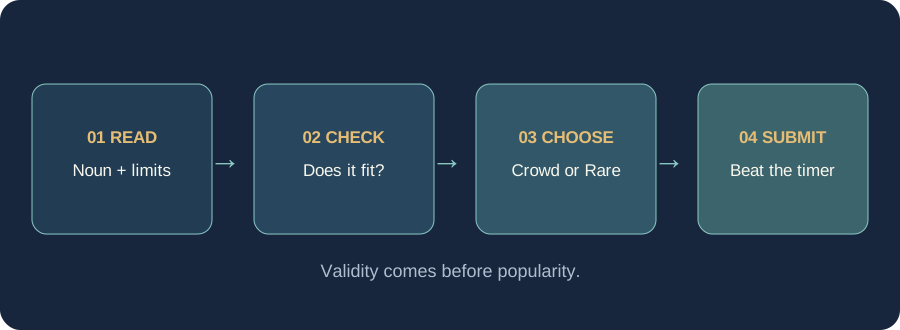
You can compress this guide into five seconds of attention: noun, filter, proof, mode, submit. The noun identifies the thing to name. The filter defines the subset. The proof connects your candidate to the subset. The mode tells you whether to favor familiarity or obscurity among eligible candidates. Submission ends the decision before the timer expires. This sequence becomes faster with practice because the steps are short and repeat across topics.
If you are repeatedly rejected, slow down on noun and filter. If you are consistently accepted but score low, focus on the mode prediction. If you time out, shorten the comparison and submit the first defensible answer. These are different failure points. A player who identifies the right cause can improve without memorizing a catalogue of possible answers.
The practice workbook gives more invented prompts to apply this method. Use Crowd mode strategy and Rare mode strategy for the popularity decision that follows a valid answer.
Keep exploring
Practice these ideas in the game, then compare your choices with the reveal. A scoring band is feedback for the next question, not a guarantee about a future answer.