
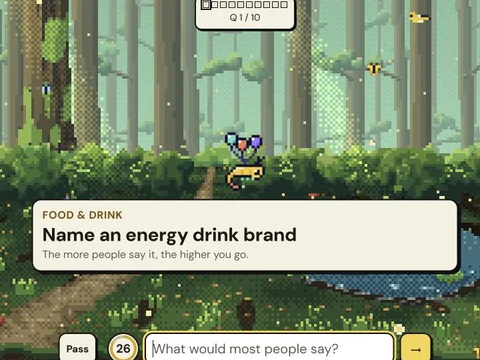
The objective in Crowd mode
Crowd mode rewards a valid answer that people are likely to name. The familiar response often beats a clever response, but the prompt still defines what counts. The strongest play is not merely to say a famous thing. It is to identify the first defensible example that a broad group would retrieve from this exact category. The game's prepared popularity estimate assigns the band, so no player can know the result with certainty before the reveal. You can, however, improve the quality of your prediction by separating three questions: Does it fit? Is it easy to recall? Is it easy to name in the form the game expects?
Consider a practice prompt, invented here, asking for a fruit. Apple may be a strong prediction because it is a default example in many English-language contexts. If the prompt instead asks for a tropical fruit, the same word no longer fits. If it asks for a fruit used in a particular dish, a different example may dominate. Crowd strategy starts with the restriction, then considers the social default within that restriction. A remembered top answer to one question is not automatically the top answer to the next.
Find the shared default
A shared default is an answer that appears quickly in many minds. It may be a prominent object, a familiar brand, a famous place, or the example used when people teach the category. Imagine explaining the category to someone who has never seen this exact prompt. What example would you say first? Then imagine a player with only a few seconds. Would that player reach for the same thing, or would a different example be more immediate? This two-person check helps counter your private associations. Your first thought may reflect what you saw yesterday, not what a broad group will recall.
Visibility and category fit interact. A city may be famous worldwide yet a poor answer to a narrow civic or geographic condition. A sports star may be recognized by casual fans yet not meet an award requirement. Once you find a shared default, run a short eligibility check before typing. If you cannot explain the link to the wording, move to a safer candidate. A top band is worth pursuing, but a zero from a wrong category is an expensive trade when an accepted answer was available.
When a category has many similar examples, ask which one owns the category in everyday speech. A prompt about a board game may draw different answers from enthusiasts and occasional players. A prompt about a musical instrument may draw a different first answer from a pianist and a person who has never played. In Crowd, your personal expertise can create a blind spot: the examples most vivid to you may be obscure to a general audience. Expertise remains useful for checking validity, but the popularity decision asks you to step outside your own experience.
Read modifiers before nouns
The broad noun in a question is often the easiest word to notice and the least useful word to ignore. “Name a country” opens a huge space. “Name a country with a specific feature” creates a smaller one. In the smaller space, a familiar answer can change. Treat every modifier as a filter: place, era, size, material, role, or achievement. Mentally rewrite the question as “I need one member of this exact subset.” That rewrite protects you from using the right kind of object for the wrong version of the question.
An invented prompt such as “Name a capital city in Europe” shows why this matters. Paris and London are prominent, but the purpose of the exercise is not to claim a universal ranking. A player needs to verify that the city is a capital and that the game's intended scope includes it. A city such as Barcelona is highly familiar but fails the capital condition. More familiarity cannot repair that failure. The right sequence is eligibility, probable familiarity, then entry.
Some modifiers make the category ambiguous. If the wording asks for something “associated with” a place or activity, there may be several interpretations. Prefer an example with a direct connection that most players would recognize. In a timed game, a borderline answer carries two risks: the game may reject it, and even if accepted, many players may not share the association. A straightforward answer can beat a technically arguable one because it is both easier to validate and easier to predict socially.
Build a three-answer shortlist
You do not need to solve the entire answer board. A shortlist of three is enough for most decisions: the obvious candidate, the second familiar candidate, and the safe backup. The obvious candidate is what first comes to mind after the eligibility filter. The second familiar candidate matters when your first thought was unusually personal. The safe backup matters when the game does not recognize a spelling or the first candidate turns out not to fit. This is a mental shortlist, not a requirement to type three answers.
Compare candidates by expected recall, not by which fact is more impressive. An answer can be technically more interesting and still be less likely to occur to other players. If you find yourself defending a candidate with a long explanation, it may be a good fact but a weak Crowd prediction. A useful Crowd answer often has a short explanation: “Most people know it, and it clearly fits.” Do not mistake simplicity for lack of skill. The skill lies in predicting a shared association under time pressure.
When two candidates feel equally common, choose the one you can submit cleanly. Avoid spending the last seconds on a debate between near equals. The difference between two plausible bands may be smaller than the cost of missing the question. The later multipliers make this especially important: preserving a valid answer on a late question can be worth more than chasing a speculative improvement. See the scoring guide for the exact weights.
Use the reveal to calibrate
After a round, compare your prediction with the displayed band. If an answer landed lower than expected, ask why. Was there a more iconic example? Did the question contain a modifier you underestimated? Was your candidate a specialist's answer? If it landed higher than expected, your sense of a shared default may have been better than you thought. The prepared estimate is the game's scoring rule, not a live survey, so the best use of the reveal is calibration for similar decisions rather than a claim about human behavior everywhere.
Record the type of mistake, not just the answer. “I overvalued a local example,” “I missed the time period,” and “I switched away from an obvious answer without a reason” are habits you can work on. Memorizing a single top answer is less transferable because the next prompt will be different. The category might be similar but the boundaries, wording, and answer list can change.
Practice prompts: everyday categories
Try “Name a hot drink” as an invented exercise. Tea and coffee are obvious candidates in many contexts, while a specialized preparation may be valid but less broadly recalled. Now change the prompt to “Name a hot drink made from leaves.” The filter shifts the decision. The most famous hot drink overall is not necessarily eligible. This small change demonstrates why a Crowd routine begins with the exact words, even when the category appears easy.
Try “Name a household appliance.” The first object you see in your own kitchen may not be the default for most players. Think about what appears in many homes and is named with one familiar word. Then change the question to “Name an appliance used to prepare food.” Some candidates fall away. In a timed setting, it is useful to notice that the subset still contains common examples. You do not need a clever edge case to earn points.
Try “Name a sport played with a ball.” A very popular sport may be a strong candidate. Now change the question to “Name an indoor sport played with a ball.” The wording removes some obvious responses. Before choosing the most familiar remaining sport, check whether the game is asking for a sport, an event, or a piece of equipment. These practice prompts are editorial exercises; they do not assert any live Crowdict bands.
Practice prompts: places and culture
Try “Name a European country.” It is tempting to choose the country you know best. For Crowd, imagine a casual player in the game's language context and the countries that appear often in travel, sport, news, and school. If the prompt adds a feature such as “has a coastline,” filter first. A famous landlocked country would fail, regardless of popularity. If you are unsure about a borderline geographic definition, a clear example is usually the safer timed choice.
Try “Name a musical instrument.” A musician may think of a specialist instrument because it is close to daily life. A broader audience may think of a piano or guitar. The exercise is to separate personal familiarity from social familiarity. Now imagine “Name a string instrument.” The instrument must fit the family; a popular instrument from a different family is not useful. You can often make the correct Crowd move by doing one second of classification before considering rank.
Try “Name a fictional detective.” The first character in your favorite series may not be the first character a wider audience would recall. Cultural defaults differ by age and region, so there is no foolproof mental poll. Use widely taught or frequently adapted figures as clues, but do not assume that fame alone is the answer. The prompt might specify a medium, an era, or a country. Treat those details as the actual game and fame as the second decision.
When not to chase the top band
There are situations where uncertainty about the very top answer is too high to justify hesitation. A wide category may have several plausible defaults, and the game's estimates may place them close together. A narrow category may leave you with one answer you know and another you only half remember. Choose the answer you can defend. Crowd mode gives points to accepted answers below the top band; it is not all or nothing. A valid Runner-up or Top 5 answer can keep a run healthy.
Do not repeatedly submit near-identical variants because you dislike a result you anticipate. If an answer is accepted, its band is set. If it is rejected, a clean alternate candidate is more useful than a flurry of speculative spellings, unless the first text has an obvious typo. The creator notes that answer lists are not complete, so there may be edge cases. Keep your play routine robust to that imperfection.
A practical Crowd checklist
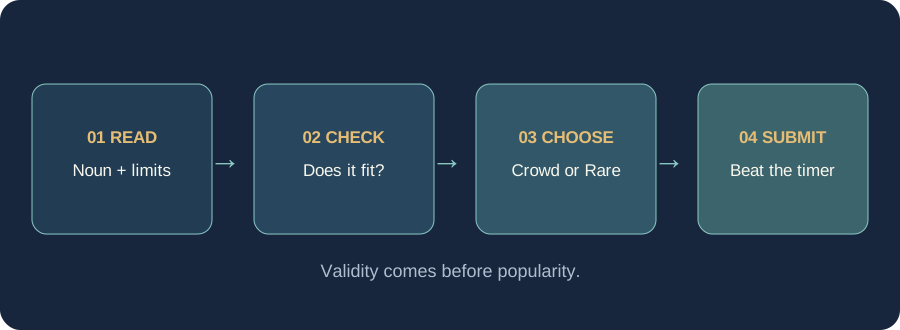
- Restate the prompt's exact category and restrictions.
- Think of what a broad group would retrieve quickly, not what you personally encountered recently.
- Reject famous examples that do not meet the condition.
- Keep a safe backup ready if your first candidate is not accepted.
- Submit before the timer turns a good answer into zero.
- After the reveal, note the reason your predicted band differed from the actual band.
For the opposite scoring direction, see Rare mode strategy. To understand why a good Crowd answer can matter more on later questions, continue to Scoring and multipliers.
Keep exploring
Practice these ideas in the game, then compare your choices with the reveal. A scoring band is feedback for the next question, not a guarantee about a future answer.