
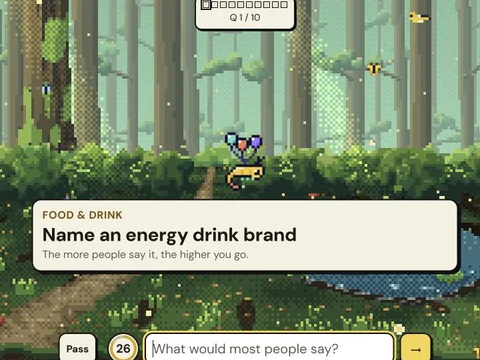
Choose the session you want
Crowdict offers several ways to play around the same central idea: name a valid response and choose whether common or uncommon answers should do better. The Daily is the shared ten-question event, refreshed at midnight in your local time. Unlimited gives you additional runs when you want more practice. Stages change the scene around the Daily while retaining the questions and scoring. The archive lets you revisit an earlier Daily. These options serve different purposes, so decide what you want from the session before you begin: a fresh shared result, an experiment, a replay, or a change of atmosphere.
The Daily is most useful when you want a clear comparison with other players on the same date and mode. Everyone receives the same ten questions for that local date. Crowd and Rare use those questions with separate scoreboards. A later stage choice does not create a different set. This makes the Daily feel like a short appointment rather than an endless practice feed. If you enjoy routines, choose a time when you can give the ten prompts a few undistracted minutes. A rushed run in a noisy place may tell you more about interruption than about strategy.
Before you start the Daily
Choose a mode deliberately. Crowd asks for widely recalled valid answers; Rare asks for less widely recalled valid answers. If you alternate between them, pause long enough to switch your mental objective. One easy mistake is to choose Rare and then automatically type the first familiar response as if you were playing Crowd. Another is to choose Crowd and become attached to an ingenious answer that few people would name. The same prompt supports both decisions, but the score rewards different instincts.
Pick a stage you can read comfortably. The creator offers Sky Climb, Tabletop, Frozen Peak, and Haunted Manor. The stage changes the visual setting, not the Daily questions or points. If you are new, choose the view that makes the prompt and answer entry easiest to follow. If you enjoy visual variety, switch later without treating it as a new attempt at the day's questions. The interface may remember progress in your browser, but browser storage can be affected by private mode, cleared data, device changes, and cross-site embedding. If persistence matters, the direct creator site is the safest place to confirm your saved session.
Give yourself a small preparation routine. Close distractions, make sure the keyboard works, and decide whether you will use a short three-answer shortlist or submit your first clear candidate. You are not studying a fixed answer key; a new Daily is meant to be answered live. Preparation is about reducing avoidable friction. On a phone, ensure you can see the whole prompt above the keyboard. On a desktop, keep the game in a comfortable size. A fullscreen button on this independent portal can make the embedded game larger if your browser supports it.
During the ten questions
Treat every prompt as a separate decision. The first two questions have a ×1 multiplier, questions three through five ×2, questions six through eight ×3, and the last two ×4. The rising weights explain why a strong finish changes the total, but they do not make the early rounds disposable. A valid answer in every round builds a dependable base. A pass or timeout is zero regardless of the multiplier, so your first priority is to protect a response you can defend.
Read the whole wording before searching for an answer. Identify the category, the condition, and the mode's popularity target. Then retrieve a safe candidate. If you have time, compare it with one candidate that may suit the mode better. If the answer is rejected, the creator says you can try another while time remains. Avoid using the entire clock to troubleshoot a borderline response. The next best valid answer is often more valuable than trying to prove the first one should have counted.
After each reveal, give yourself a moment to notice the band and points. A poor band is not a reason to rush the next prompt. It is a small piece of information about how this specific answer scored under the game's estimate. Ask whether you misread the category, misjudged familiarity, or simply encountered an unexpected ranking. Then reset for the next card. Carrying frustration forward can produce more mistakes than the original low score.
What to do after a run
Review the total as a sum of ten decisions, not a single verdict. If you finished with several valid lower-band answers, your next practice target might be identifying more salient Crowd defaults or less salient Rare examples. If you timed out repeatedly, focus on submission timing. If answers were rejected, focus on reading restrictions and choosing clearer conventional names. Different problems need different remedies; “learn more trivia” is only one possible response.
You can share the game's result and compare a Daily score on the matching leaderboard. Be careful when comparing a Crowd run with a Rare run or one day with another. The questions, mode, and eligibility for a public board matter. The creator's leaderboard explains which Daily score counts and how ties are ordered. A score is most informative when the comparison group faced the same prompt set and scoring goal.
If you want to play more immediately, use Unlimited. It does not replace your Daily streak or result. The creator describes ten-question, twenty-question, and endless options, with mixed questions or a chosen topic. This makes Unlimited a practical training space. You can repeat a process, such as always identifying the limiting word before typing, and see whether it improves your acceptance rate. The point of practice is to refine a habit you can carry into tomorrow's new questions.
Use Unlimited with a specific aim
An unstructured run can be fun, but a focused one can teach you more. Pick one mode and one behavior. In Crowd, you might test whether your first eligible answer is usually more salient than the second. In Rare, you might test whether waiting five extra seconds produces a genuinely less common valid answer or merely more timeouts. Record what happened in ordinary language after the run. A small sample will not prove a universal rule, but it can reveal your own recurring mistakes.
Topic selection helps when a field is unfamiliar. Rather than memorizing lists without context, practice recognizing the shapes of prompts in that topic. Do they ask for people, places, objects, or achievements? Which words narrow eligibility? Are you quick at retrieving one safe example? A player can improve substantially by learning to recognize a category's boundaries even without becoming an expert in every fact it contains.
Endless play can be useful for fluency, but fatigue changes decision quality. When you notice yourself skipping qualifiers or submitting before checking, take a break. A shorter deliberate run may improve your Daily habits more than a long sequence played on autopilot. Unlimited repeats the multiplier pattern every ten questions, so you can use ten-question blocks as natural review points. Ask what you predicted, what the reveal showed, and which decisions were avoidable errors.
Stages, archive, and saved progress
Stages are presentation choices. Sky Climb uses a rising journey, Tabletop makes the crowd visible, Frozen Peak uses a mountain setting, and Haunted Manor uses rooms. The same Daily questions, answers, and progress carry between stages in the same browser, according to the creator. Choose a stage for clarity or enjoyment. Do not switch expecting to reset the questions or change the scoring band of an answer.
The archive lets you replay previous Daily question sets. The creator says replays use Crowd scoring, contribute to that day's percentile, and do not change your current Daily streak. Older replays do not enter a leaderboard after it has closed. Treat the archive as a way to revisit prompts and practice rather than a substitute for a fresh Daily. You can learn from an old set without needing to preserve the suspense of today's shared questions.
Progress is stored in the browser when storage is available. That is convenient but local storage is not the same as a permanent cross-device account. If you clear site data, use private browsing, change devices, or encounter restrictions in an embedded frame, progress may not follow you. This independent site embeds games operated by GuessPark; it does not operate the account system. If your run fails to resume here, open the direct game at crowdict.com and check there. Do not assume the embedded view has the same storage behavior as a direct visit.
A one-week improvement plan
On day one, finish a Daily without trying to optimize every answer. On day two, write down three prompts where you noticed a limiting word. On day three, predict the band of each answer before the reveal. On day four, play a short Unlimited run in the mode you find harder. On day five, practice one topic and focus on clear eligibility. On day six, try the other scoring mode to expose different instincts. On day seven, review your notes and choose one habit to keep. This plan is a practice suggestion, not a game feature or a guarantee of a higher score.
You can keep the notes extremely short. “Question 7: safe answer, submitted late,” “Question 9: missed date condition,” and “Question 10: expected common, got lower band” are useful. They point to decisions you can change. A list of correct words without the prompt condition is much less useful. Crowdict changes questions, so the transferable skill is reading and choosing under a clock.
Quick session checklist
- Choose Crowd or Rare before the run and remember the goal of that mode.
- Read the prompt's category and limits before ranking answers.
- Keep a safe valid answer available as time runs down.
- Interpret the reveal as feedback on this answer and question.
- Use Unlimited for practice and the archive for earlier question sets.
- Pick stages for presentation, not for a scoring advantage.
- Check the direct creator site if embedded storage or resuming behaves unexpectedly.
For a deeper look at choosing answers, continue to Crowd mode strategy or Rare mode strategy. For point calculations, see Scoring and multipliers.
Keep exploring
Practice these ideas in the game, then compare your choices with the reveal. A scoring band is feedback for the next question, not a guarantee about a future answer.