
Basketball knowledge becomes a shot
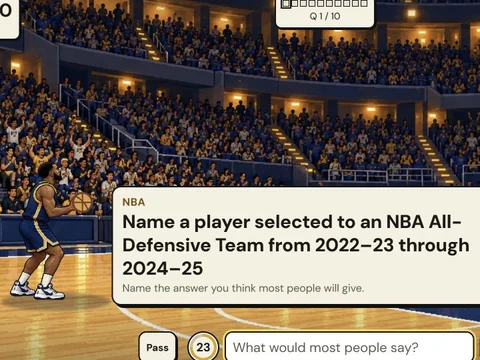
Crowdict NBA asks for a player who fits each of ten basketball prompts. You have thirty seconds for a question. Choose Crowd if you want widely recalled correct players to perform best, or Rare if you want less obvious eligible players to perform best. A correct answer becomes a basketball shot worth one, two, or three points according to its band. A pass or timeout becomes a miss worth zero. Ten three-point answers make the maximum 30. The game's player rankings are described by its creator as provisional estimates, so this guide treats exact band predictions as strategic guesses rather than facts.
An NBA prompt can ask about awards, contests, draft positions, scoring achievements, or another defined group. The card may include a year range. These conditions matter more than how famous a name is. A Hall of Fame player may still be invalid for a specific award; a recent star may be outside an earlier cutoff. Read the whole card before entering a player. The strongest answer for your mode begins with eligibility, not celebrity.
Read the condition like a roster rule
Translate the prompt into a sentence you can test: “This player won this award,” “This player was selected first overall,” or “This player led this statistic in the relevant period.” If you only know that a player was associated with the topic, that may not be enough. A finalist is not necessarily a winner. A high draft pick is not necessarily the first pick. A season with a memorable performance may not be the season specified on the card. This precision is the main defense against a rushed zero.
Practice with an invented prompt: “Name a player who won a three-point contest during the stated years.” A famous shooter is an attractive name, but shooting skill alone does not prove a contest win. If you can remember a specific victory, you have a better candidate. If the question ends before that victory, the player may still be excluded. The example illustrates method, not the current game's accepted list or any particular player's record.
Another invented practice prompt might ask for a Finals MVP. A player who helped a team win a title did not necessarily receive that award. A player who won regular-season MVP in the same year may also not be the Finals MVP. Crowdict NBA rewards a member of the exact group. The score mode ranks eligible members; it cannot turn a neighboring basketball fact into the required one.
What the three shot values mean
The two highest answer bands become three-point shots. The middle band becomes a two-point shot. The two lower valid bands become one-point free throws. A pass or timeout yields a missed shot. The court animation places the player at the corresponding location before the shot, and the result card shows the answer and points. The shot is a visual way to present the band. It is not determined by whether the real player was known for shooting from that distance.
Suppose you have three accepted answers in a practice sequence: one in a top band, one in the middle, and one in a lower valid band. They contribute 3 + 2 + 1 = 6 basketball points. If the next round times out, the total stays 6. The maximum after four rounds would have been 12, but a single miss does not end the ten-question run. Each later possession is another chance to add one, two, or three. NBA's total is its own scale; do not apply the Daily's weighted 2,500-point system to the court.
You can skip an animation to reach the result card sooner. Use that option if you prefer a quicker review of the answer and points. If you enjoy the court scene, watch how the location reflects the band. Either way, focus on the eligibility test and revealed result. The animation does not change a submitted answer's score.
Crowd strategy for NBA prompts
In Crowd, consider which eligible player a casual basketball fan would retrieve first. A global star may be an excellent candidate when the card describes an achievement that star actually earned. Fame without eligibility is the trap. Look for a connection you can name clearly: the award, the draft, the contest, the season, or the statistical title. If two eligible players come to mind, choose the one you believe is more widely associated with that specific achievement.
The prompt can make a less globally famous player a more common answer. For example, a contest may have one winner strongly associated with it, even though a more famous player is better known overall. Ask “Who is famous for this condition?” rather than simply “Who is famous?” That phrasing pushes your prediction toward the actual basketball category. The prepared answer rankings can still surprise you, but the reasoning is sounder.
Do not assume the most recent player will always be the default. Fans of different generations remember different eras, and the game may include a wide year range. Recent exposure is one clue to salience, not a rule. If you know a famous historical winner and a recent but less prominent one, compare both against the exact prompt. A name that is easy to recall because you watched last night's game may be a personal default rather than a broadly shared one.
Rare strategy for NBA prompts
In Rare, search for an eligible player beyond the first obvious star. Earlier seasons, less celebrated winners, and players associated with a particular team or era can provide candidates. But you need a factual anchor. If you cannot recall the award or accomplishment that makes the player eligible, the name may be a risky guess. A less obvious correct player can produce a longer shot; an unverified one can produce no points.
Use era scanning when the card allows it. Think through a few seasons or periods instead of trying to summon one obscure name from memory. A draft prompt can be searched by remembered draft classes. An award prompt can be searched by winners you associate with a period. A contest prompt can be searched by specific events. This structured retrieval can surface a valid answer that is not the first celebrity in the category.
Keep a safe player available. If the clock is low and your rare candidate remains a vague memory, submit the player whose eligibility you know. A lower valid shot adds to the total. A timeout adds none. This is especially important because you have only ten possessions, and the maximum per round is three. Recovering from several avoidable misses is harder than accepting a one-point result when the category is difficult.
Names, correction, and the clock
The creator says the game recognizes a selection of common nicknames and small typos when it can identify one player clearly. If a name is ambiguous or absent from the current list, the game shows a message and you can edit or try another player while time remains. A rejected entry is therefore an invitation to correct the response, not necessarily an immediate miss. Still, the timer continues, so keep a second eligible player ready.
Use a recognizable full name when you can. A surname shared by several players may create ambiguity. A nickname may be accepted, but the clearest conventional form reduces uncertainty. If you mistype a long name, correct the obvious error first. If the wording itself may not be recognized, switch to your backup rather than spending the final seconds on many variations. Passing is a separate choice; an unfinished entry does not become a scored answer when time expires.
Remember that answer rankings are provisional. The creator says they are estimates made with two AI models and may change as the lists are reviewed. A band is the current game's rule, not a definitive ranking of player fame. Use the result to learn the game's scoring and your own recall habits. Avoid making confident claims about how all basketball fans would answer based on one reveal.
A ten-possession routine
Before the first question, choose the mode and commit to its objective. On each card, identify the achievement and year range. Recall one eligible player. If time allows, compare that player with a more mode-suited eligible player. Enter a clear name. If the game rejects it, inspect whether the problem is spelling, ambiguity, or eligibility, then try a backup. After the shot, note the points and reset. Do not let a miss on question three make you hurry through question four.
This routine is simple because the questions vary. A rigid list of famous NBA names cannot cover every award, season, or contest. The transferable skill is to translate a category into an eligibility test, then estimate who else would recall the same player. That makes the game both a basketball memory challenge and a prediction challenge.
Live play with basketball friends
The creator offers a live friends mode. A host can invite players with a link or code, choose Crowd or Rare and the number of questions, and play with up to ten people. Everyone sees the same NBA question at the same time. After each round, the game reveals the answers and scores. This can make a useful group discussion: one friend may remember a player from a different era; another may see why a famous candidate did not meet the prompt. Let everyone submit before discussing names so the prediction element remains meaningful.
To play the themed game, visit Crowdict NBA. For a deeper explanation of how popularity bands work in the Daily, read Scoring and multipliers. The games share the Crowd or Rare idea but use different total scales.
NBA quick reference
- Ten questions, thirty seconds per question, and a maximum of 30 basketball points.
- Read the achievement and any date range before naming a player.
- The two highest bands score three; the middle scores two; two lower valid bands score one.
- A pass or timeout scores zero, while a rejected entry can be corrected before time runs out.
- Crowd favors a widely recalled eligible player; Rare favors a less expected eligible player.
- Treat answer rankings as provisional game estimates, not live player polling.
Keep exploring
Practice these ideas in the game, then compare your choices with the reveal. A scoring band is feedback for the next question, not a guarantee about a future answer.