
What Rare asks you to do
Rare mode rewards a valid answer that fewer people are expected to give. It reverses the popularity goal of Crowd while keeping the same first requirement: the response must fit the prompt. The creator describes the answer bands using prepared estimates of popularity, not a live count of players in your session. That means you cannot discover a guaranteed high-scoring Rare answer by watching the room. You can only choose a candidate whose validity you trust and whose obscurity seems plausible. This guide focuses on that balance between certainty and surprise.
Rare is easy to misunderstand because “unusual” sounds like permission to be inventive. The game does not ask for a poetic association; it asks for a member of a category. An obscure item outside the category is worth zero. A moderately uncommon item that clearly belongs may be a better choice than a highly obscure item you cannot verify. You are managing two risks at once: the probability of acceptance and the expected band if accepted. A strong Rare player notices both rather than optimizing only for novelty.
Start with a valid anchor
When a prompt appears, name a safe example in your head first. This is the anchor that tells you what the category means. Then move one or two steps away from the default. Suppose a practice prompt asks for a European capital. A very familiar capital is a safe anchor. A smaller capital that you can confidently identify may be a stronger Rare candidate. A town that is not a capital is not a creative extension; it breaks the rule. This exercise uses invented practice reasoning, not an assertion about the game's exact ranking.
An anchor helps when time is short. If you spend twenty seconds searching for a rare candidate and cannot confirm one, you can still submit a common valid answer. In Rare it may score in a lower band, but a lower band is better than a timeout. You need not type the anchor before thinking; just keep it available. This turns Rare from an all-or-nothing memory contest into a controlled search with a fallback.
Move outward along a clear dimension. For a country prompt, the dimension might be population, location, or frequency in everyday conversation. For an animal prompt, it could be how often the animal appears in books and films. For a music prompt, it could be the difference between globally familiar and specialist examples. Do not move outward by changing the category itself. A rare country is still a country; a rare-looking landform is not an answer to a country question.
Test the exact wording
Rare responses are often more vulnerable to hidden conditions. A familiar example may be so well known that its eligibility is obvious. A lesser-known example may sit near a boundary: a disputed classification, a date cutoff, or a name that refers to several things. Read every qualifier before using an unusual candidate. If a question asks for a winner of an award in a specified period, knowing that someone was nominated is insufficient. If it asks for a capital, a famous administrative city may still be the wrong type of place.
Use a one-sentence proof: “This fits because…” If you cannot finish that sentence without adding “probably,” consider another answer. This does not mean you must know a citation during a timed round. It means your memory should include the connection between the candidate and the condition, not merely a feeling that the candidate belongs nearby. Rare often draws on deep knowledge, and deep knowledge is most useful when it includes the boundaries of a fact.
Watch for answers that are rare only in your own experience. A person who follows a niche topic may know a name extremely well and assume nobody else does. The game may have many players with the same interest, and the prepared estimate may rank the name differently. Conversely, a place you think is familiar because you lived there may be obscure to the broader player base. Treat your sense of familiarity as a hypothesis, then learn from the reveal.
Use category structure to retrieve options
Rare becomes easier when you search a category systematically rather than waiting for a random obscure example. For countries, scan regions in your mind. For instruments, scan families such as strings, winds, percussion, and electronic devices. For sports, scan indoor, outdoor, individual, and team activities. For famous people, scan eras and disciplines. This mental organization can reveal a valid answer outside the first cluster of obvious names without forcing you into a guess.
Avoid spending too long on one branch. If you cannot recall a particular island country's name, switch to another region. If an older basketball player is on the tip of your tongue, consider a different eligible era instead of burning the entire timer. Thirty seconds rewards flexible retrieval. The best system is one you can execute in seconds, not an exhaustive taxonomy.
Language can matter. A very obscure response may have several spellings or a long name you cannot produce confidently. If a shorter conventional name is available, use it. The creator says many variants and small spelling differences are recognized, but no answer directory is complete. A clear, accepted candidate that is somewhat less rare may be preferable to a hard-to-enter candidate that risks rejection. Rare measures the answer's band, not how difficult it was to type.
Practice prompts: nature and everyday life
Imagine “Name a bird.” A common backyard bird is a safe anchor. A less familiar bird you can identify with confidence may suit Rare. But a flying mammal is outside the category, even if its name feels unusual. Now imagine the prompt adds “found in a particular habitat.” Your first rare bird may no longer qualify. The exercise is to search within the filtered set, not simply to move to the most exotic word you know.
Imagine “Name a vegetable used in soup.” A familiar ingredient may be common but valid. An uncommon vegetable could be a stronger Rare choice if it is actually used in soup and the game recognizes it. A spice might be used in soup yet fail if the intended category is vegetables. When the category boundary is uncertain, choose an example whose classification is ordinary and stable. The strategic gain from obscurity disappears if the response is outside the accepted set.
Imagine “Name a musical instrument with strings.” The familiar guitar is an anchor. A less familiar stringed instrument can be a Rare candidate. A keyboard instrument may contain strings internally but may not be interpreted as a string instrument in the game's category, so a technical argument could be risky. Rare does not require you to litigate classification. It rewards an accepted answer that is less salient.
Practice prompts: places and history
Imagine “Name a country in Africa.” A player might jump to the best-known examples. Rare invites a deliberate scan across the continent, perhaps toward countries that appear less often in international entertainment or headlines. You still need to use a country that fits the game's directory. If a prompt adds “landlocked,” coastlines matter more than cultural salience. A highly obscure coastal country is invalid for that version of the exercise.
Imagine “Name a city with an underground railway.” A smaller system may be less obvious than a famous one, but you should know that the system exists. An older tram network or a planned line is not necessarily the requested thing. Rare favors knowledge with a direct factual link. If you cannot distinguish the candidate from neighboring transport categories, return to a clear valid city.
Imagine “Name a historical scientist.” A specialist may recall a less famous figure, but the prompt might further specify a century or a field. Do not assume a person's most famous work occurred within the period. A factual anchor such as a dated discovery or a known institution can help validate the candidate. These invented prompts are exercises in method and do not describe a live Daily answer list.
Manage the clock and the score
Your first few seconds should identify the condition and the safe anchor. The middle of the timer is for searching a less obvious eligible member. The final seconds are for committing. If you repeatedly reach zero while thinking, lower your rarity target. An accepted answer in the Too Popular band is still a scored answer. A timeout is not. The correct target is the best answer you can submit reliably under the actual timer, not the most obscure fact you can remember after a minute of reflection.
Later Daily questions have larger multipliers. This changes the value of a band improvement, but it also increases the cost of a zero. A player who has a strong, verifiable less common answer should use it. A player choosing between a clear ordinary answer and a vague rare possibility should consider the clear answer, especially near the end. The scoring guide shows the arithmetic. There is no need to treat every round as a desperate attempt at the top band.
Compare your results over several runs. If your Rare answers are consistently accepted but low-scoring, explore one step further from the default. If many are rejected or missed, tighten your validity check and submit earlier. If your results vary widely, the categories may be testing different knowledge areas; that is normal. Strategy can reduce avoidable mistakes, but it cannot erase differences in memory, wording, or the game's answer estimates.
A practical Rare checklist
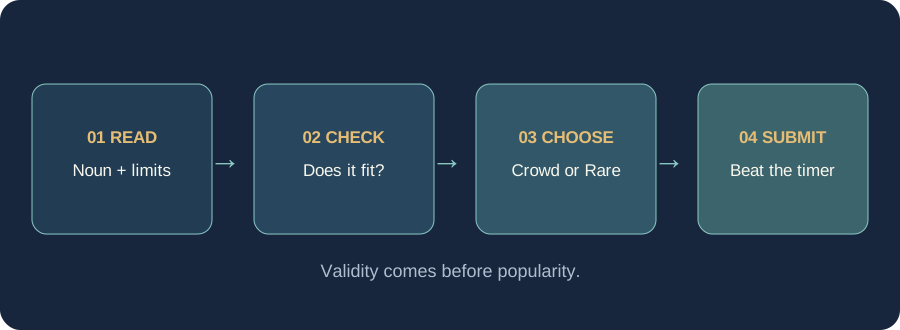
- Identify the category and each limiting word.
- Hold one unquestionably valid example as a fallback.
- Search one or two steps away from the most familiar examples.
- State why the uncommon candidate fits before submitting it.
- Choose a name you can enter clearly and promptly.
- Treat the reveal as feedback about this game's estimate for this prompt.
Read Crowd mode strategy to see how the same prompt changes when familiarity becomes the goal. The beginner guide covers the complete Daily flow.
Keep exploring
Practice these ideas in the game, then compare your choices with the reveal. A scoring band is feedback for the next question, not a guarantee about a future answer.