

Two choices, one set of Daily questions
Crowdict's Daily presents the same ten questions in Crowd and Rare. The mode changes which valid answers earn the strongest band. Crowd rewards answers expected to be more common; Rare rewards answers expected to be less common. The modes keep separate Daily scores and leaderboards. The scoring is based on prepared estimates of answer popularity for each question, not a live poll taken while you play. That distinction matters when you interpret a result: a displayed band is the rule the game applied, not a claim that a particular fraction of today's players typed your answer.
An accepted answer receives a base score from one of five bands. The question's multiplier turns that base into the round's points. A pass or timeout receives zero. The total after ten questions is the sum of the ten round scores. The maximum Daily total is 2,500 points, achieved by receiving the 100-point base on every question. You do not need the perfect result to enjoy the game, but understanding the arithmetic helps you see why a late answer can move the total so much.
The five answer bands
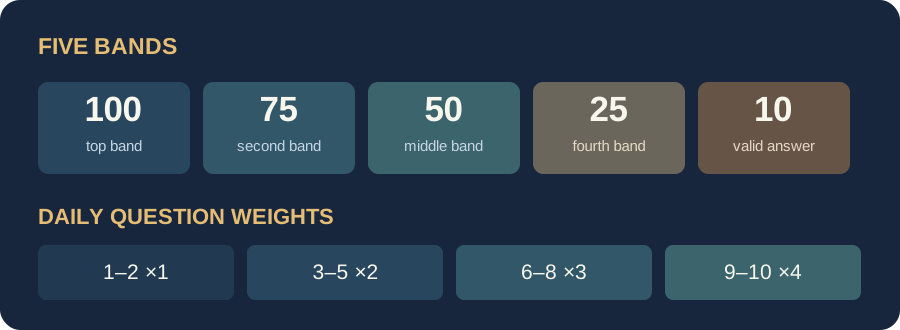
Both modes use base scores of 100, 75, 50, 25, and 10. In Crowd these are named #1 Answer, Runner-up, Top 5, Top 10, and Off the Board. In Rare the corresponding names are Lone Wolf, Hidden Gem, Uncommon, Common, and Too Popular. A name can sound flattering or disappointing, but the number is what enters the total. An answer in the bottom valid band still earns points, while a pass or timeout earns none.
In Crowd, the board's most popular answer earns 100. The second and third positions earn 75; fourth and fifth earn 50; sixth through tenth earn 25. Another accepted answer beyond that board earns 10. Rare organizes accepted answers by how uncommon they are under the game's estimates. The top five popular answers fall into Too Popular, the 10-point band. The same valid answer can therefore feel strategically opposite in the two modes: a familiar response may be a Crowd success and a Rare low band.
The band is attached to a particular question. “Paris” may be a natural response to a prompt about European capitals and irrelevant to a prompt about coastal towns in another region. Even within valid prompts, relative popularity can change with wording. Never treat a band as a permanent property of a word. Your job during play is to judge the current category, not to memorize a global list of strong answers.
How multipliers work
Questions one and two use a ×1 multiplier. Questions three through five use ×2. Questions six through eight use ×3. Questions nine and ten use ×4. The pattern means the first two rounds can contribute up to 200 points, the middle three up to 600, the next three up to 900, and the final two up to 800. Together those maxima are 2,500. Unlimited repeats this weight pattern every ten questions. A stage changes the presentation, but it does not change this scoring rule.
To calculate a round, multiply the band score by its question weight. A 75-point base on question four earns 150 because question four is weighted ×2. The same base on question nine earns 300 because the weight is ×4. A 10-point accepted answer on question nine earns 40. A pass on question nine remains zero, because multiplying zero by four does not change it. This simple arithmetic explains why protecting a valid answer late in the game can be important even when it is not your preferred band.
Consider an invented five-round sequence: 100 on question one, 25 on question two, a 50-point base on question three, 75 on question four, and a pass on question five. The points are 100 + 25 + 100 + 150 + 0 = 375. The multiplier applies to each question's base before the scores are added. You do not multiply the running total at the end of a block. This is a useful distinction when the animated stage emphasizes the final movement rather than the arithmetic.
A worked ten-question example
Imagine a practice run with base scores 50, 75, 25, 100, 10, 50, 75, 25, 100, and 10. These figures are invented to demonstrate calculation; they are not a recorded Daily result. The first two rounds give 50 and 75. The next three give 50, 200, and 20 after ×2. Questions six through eight give 150, 225, and 75 after ×3. The final two give 400 and 40 after ×4. Add them and the practice run totals 1,285 points.
Notice how the same 10-point base contributes only 20 on question five but 40 on question ten. The low band does not mean the final question was worthless. Likewise, a 100-point base early is still useful even though it has no multiplier. If you chase only the late questions, you discard reachable points in the opening rounds. A good run is a sequence of ten valid decisions, with extra care on the weighted finish.
The game also offers stage-specific visual progress. On Sky Climb, points lift the character; on Tabletop, the crowd comes toward your side; other stages present the result in their own scenery. The visual journey is a way to feel the same score. Switching stages does not produce different questions or a more favorable band. If you enjoy the animation, use it as feedback, but read the numeric points and band to understand what happened.
What the score can and cannot tell you
A high total means you earned strong bands across weighted questions. It does not prove you know more facts than another player. Crowd emphasizes predicting common responses, while Rare emphasizes finding uncommon valid ones. Someone can know a great many examples yet choose a lower-scoring one for the selected mode. The total is a measure of performance under the game's rules for that set of questions, not a general test of intelligence or expertise.
A single question's result can also be surprising. The game's popularity estimates are prepared in advance and may not match your social circle's answers. Use the result as game feedback. If you thought an answer would be #1 and it landed Off the Board, ask whether a more salient answer was available or the prompt's wording narrowed the category. If you thought an answer was very rare and it landed Too Popular, perhaps it was more widely recalled than you expected. Neither conclusion should be turned into an unqualified claim about the whole world.
The Daily leaderboard compares players in the same mode and day's question set. An archive replay can let you revisit earlier questions, but the creator describes different rules for how a replay affects streaks and rankings. Compare like with like: the same date, mode, and eligibility for the board. A score from a different mode, a different day, or another themed game is not directly comparable just because the screen displays a number.
Decision making under multipliers
The band gaps are 25, 25, 25, and 15 base points between adjacent valid tiers. On question ten, a move from 75 to 100 base adds 100 points. A move from 10 to 25 adds 60. But a failed attempt to replace a known valid answer with an invalid one can lose all the points the known answer would have earned. The arithmetic encourages thoughtful improvement, not reckless novelty. You need a reason to believe the replacement is both valid and better suited to the mode.
In Crowd, a familiar valid candidate may justify an early submission, particularly if you cannot identify a clearly more popular one. In Rare, a less obvious candidate may justify a few seconds of search, but a safe accepted answer should remain in reserve. On the final two questions, make your cutoff explicit: if the timer is nearly gone, enter the best defensible response you have. The fourfold weight amplifies a good answer and the cost of a zero.
Themed games use their own totals
Crowdict Geo offers ten country questions with base scores of 10, 25, 50, 75, or 100 for a correct response. Its maximum is 1,000 points, translated into a journey of up to 40,000 game kilometres. Do not apply the Daily's ×1 to ×4 pattern to that travel total. Crowdict NBA turns the answer bands into basketball shots: the two highest bands yield three points, the middle band two, and the two lower valid bands one. Ten three-point shots make a maximum of 30. The themes use the Crowd or Rare idea while presenting their own score scales.
For strategic advice in each format, use the Geo guide and NBA guide. If the number you see on a themed screen seems unfamiliar, identify its unit first: Daily points, travel distance, or basketball points. Then compare it only with results from the same game and mode.
Quick scoring reference
- Daily base scores are 100, 75, 50, 25, and 10 for accepted answers.
- Daily weights are ×1 for questions 1–2, ×2 for 3–5, ×3 for 6–8, and ×4 for 9–10.
- Passes and timeouts score zero; the maximum ten-question Daily is 2,500.
- Crowd and Rare use the same base numbers with different band names and opposite popularity goals.
- Popularity is a prepared estimate for the question, not a live poll.
- Geo and NBA have their own total scales, so compare scores within the same game.
Keep exploring
Practice these ideas in the game, then compare your choices with the reveal. A scoring band is feedback for the next question, not a guarantee about a future answer.